 WMO
Verra introduces Article 6 labels to reflect interacts with Paris Agreement

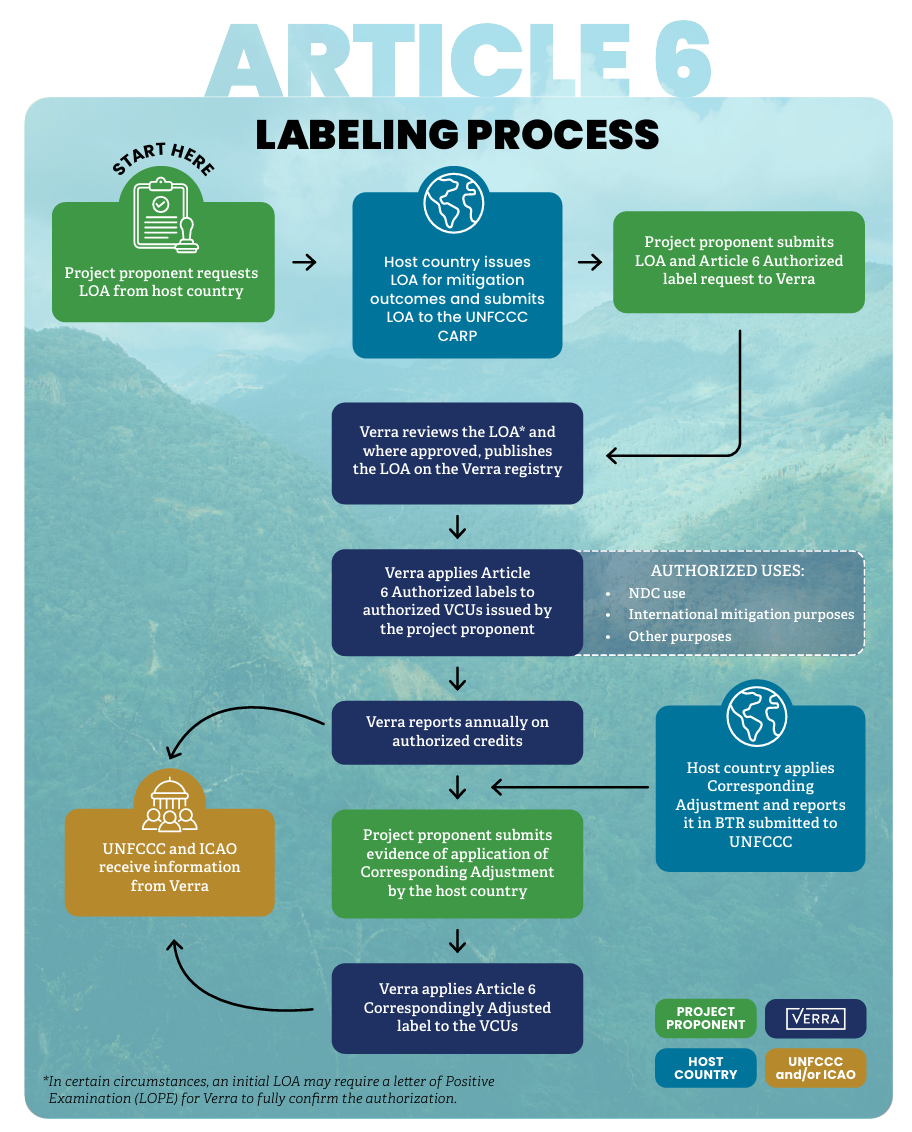
Verified Carbon Standard (VCS) Program may receive Article 6 labels at different stages of the project certification cycle to indicate that the VCUs have been authorized for specific uses by a host country’s government under Article 6 of the Paris Agreement.
Verra established these labels to ensure the VCS Program is Paris-aligned, and to reflect how signatory countries to the Paris Agreement must account for their climate action and to avoid any risk of double counting of mitigation outcomes toward climate targets. Article 6 labels are optional under the VCS Program, as not all uses of VCUs require authorization from the host country’s government. Where a Corresponding Adjustment (CA) is required, the labels are necessary for retirement against certain retirement purposes in the Verra Registry. CAs may be required in bilateral agreements between governments under Article 6.2, within the scope of the Carbon Offsetting and Reduction Scheme for International Aviation (CORSIA), or in the context of broader, regional or global agreements.
Cooperative Approaches
Reporting and accounting under Article 6 are structured around cooperative approaches, which are voluntary mechanisms that allow the government of a country hosting projects to transfer mitigation outcomes to another country (ITMO) for use in their NDC, to an international mitigation program such as CORSIA, or for other purposes.
Authorization and Corresponding Adjustments
Via letters, host countries provide authorization for specific uses of the mitigation outcomes that VCUs represent (i.e., reductions and removals). Article 6 Decisions and Documentation under the UNFCCC establish the requirements for authorization, which host countries often operationalize by specifying procedures in domestic regulations or through bilateral agreements. The purpose of such authorization is to ensure that where a mitigation outcome is achieved within one country’s national boundaries and transferred to another country for use toward its NDC, Corresponding Adjustments (CAs) are made. is guarantees that the mitigation outcomes are only counted toward one country’s NDC and avoids the risk of double counting. Such transferred mitigation outcomes must be accounted for in the year in which they occur, meaning that any CA must be applied within the NDC implementation period that includes that year (e.g., if a VCU represents mitigation that occurred in 2027, the CA must be reported in the 2026–2030 NDC period). Each host country is required to inform the UNFCCC of its method for applying CAs, which must be documented in the CARP.
First Transfer Conditions
Authorization does not always immediately trigger an obligation to apply CAs. e Article 6 rules state that CAs are needed when the appropriate use has been authorized and a “first transfer” occurs.
These rules allow host countries flexibility to define what conditions comprise a “first transfer.” From an operational perspective, the first transfer condition defined by the host country has direct implications for when CAs are expected to occur and be reported. Clear specification of this condition in the authorization helps align expectations among governments, project proponents, and buyers regarding the timing of accounting obligations under Article 6.
Overview of Verra’s Article 6 labeling process throughout the project lifecycle