Key Milestones and Implications of the Transition from CDM to PACM
According to official documents of the United Nations Framework Convention on Climate Change (UNFCCC) and the latest resolution adopted in December 2025, the Clean Development Mechanism (CDM)---which aims to help developed countries fulfill their quantified emission reduction obligations at a lower cost while promoting sustainable development in developing countries---will gradually transition to the “Paris Agreement Accounting Mechanism” (PACM, i.e., the mechanism under Article 6.4 of the Paris Agreement).

Prior to the conclusion of the transition process on December 31, 2026, the CDM mechanism has established the following key milestones:
a、The Clean Development Mechanism (CDM) Registry will be disconnected from the International Transaction Log (ITL) on March 31, 2026, but will retain its issuance and cancellation functions within the registry;
b、Effective June 30, 2026, the acceptance of applications for the issuance of Certified Emission Reductions (CERs) will cease;
c、Effective December 31, 2026, the acceptance of applications to transfer CERs to the Paris Agreement Article 6.4 mechanism registry will cease; this includes the cancellation of CERs and any other transactions within the CDM registry;
d、On July 1, 2027, all CERs in pending settlement accounts for which the share of proceeds (SoP) to cover administrative expenses has not been paid will be administratively canceled;
e、On July 1, 2027, the registry administrator will complete the administrative cancellation of the aforementioned CERs for which the SoP to cover administrative expenses remains unpaid, and the CDM registry will simultaneously cease all operations.
“CDM Registry Application Submission Schedule”
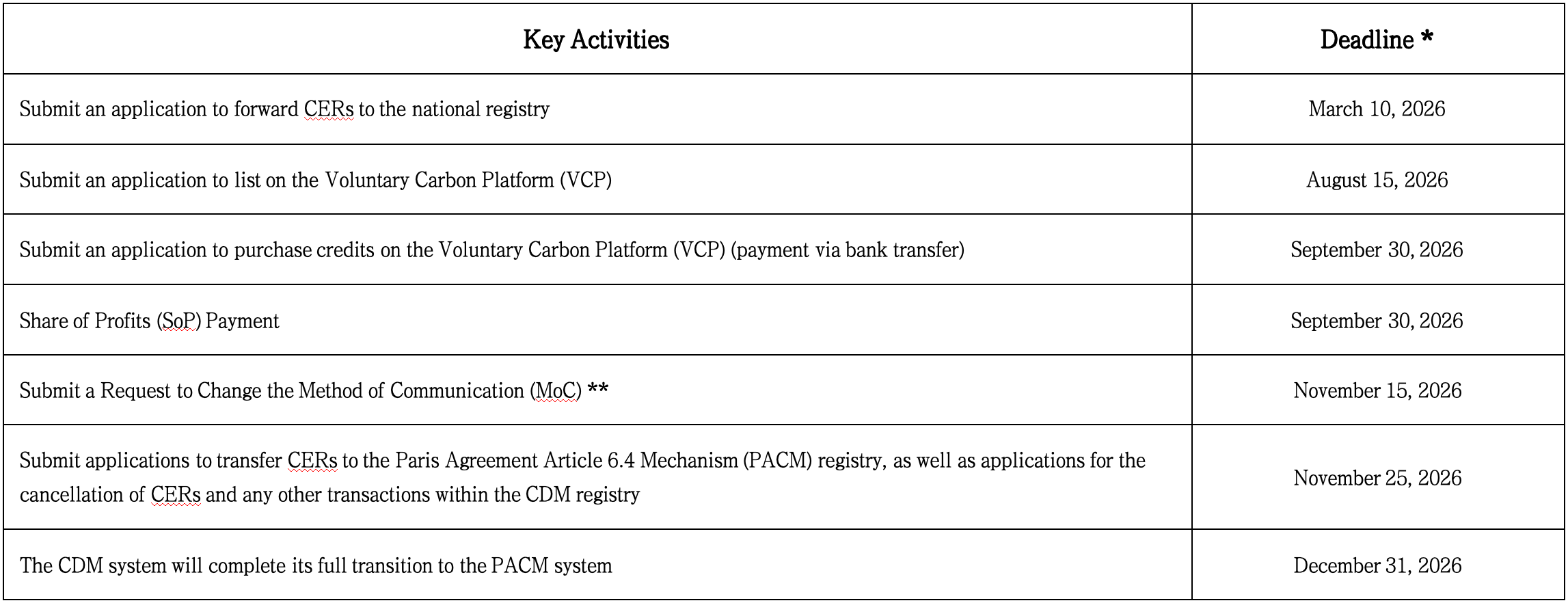
Notes:
* Applications received by this date are guaranteed to be processed;
** If the timeline for an administrative withdrawal by a project participant or a voluntary withdrawal by a focal point cannot be guaranteed for processing by the applicable deadline, these rules shall prevail.
A preparatory phase is required to determine the deadline. For applications received after the aforementioned timeline, the Secretariat cannot guarantee that processing will be completed by December 31, 2026. Any decisions regarding the applicable timeline will be published in a transparent and timely manner.
Impact of the Transition from CDM to PACM on the global carbon credit market:
Revaluation of Existing Carbon Assets: Of the 980 million metric tons of registered carbon assets worldwide, 127 million metric tons have completed the transfer registration (as of December 23, 2025; data sourced from online information). Successfully transferred carbon assets are endorsed by the United Nations and can be used for NDC compliance, international aviation carbon offset and emission reduction programs, and trading in high-quality voluntary carbon markets; untransferred carbon assets will depreciate to varying degrees and will be limited to circulation in regional voluntary markets.
Upgraded Carbon Asset Quality Standards: The PACM mechanism adopts stricter BAT baselines and a mechanism for annual downward adjustments of at least 1%, replacing the CDM mechanism’s lenient BAU baselines; additionally, additionality must pass a four-dimensional test. For forestry projects, a monitoring-based “durability” assessment has been introduced, requiring the establishment of a reversal risk reserve or insurance.

Market Structure and Pricing Restructuring: Carbon assets assessed as having high integrity following the completion of the transition are expected to command a premium of 30% - 50%, and the market will accelerate the phasing out of low-quality carbon credit projects. Given that China possesses a vast amount of potential carbon assets, the registration and transfer of these assets may influence global carbon market supply and demand.
Special Support for Forest Carbon Credit: Given the long project cycles and substantial investment requirements of forest carbon credit projects, the UNFCCC has specifically extended the deadline for transition applications to December 31, 2026. It has also established a risk pool and additional support mechanisms to address potential carbon credit reversals and to encourage the integration of biodiversity and community development.